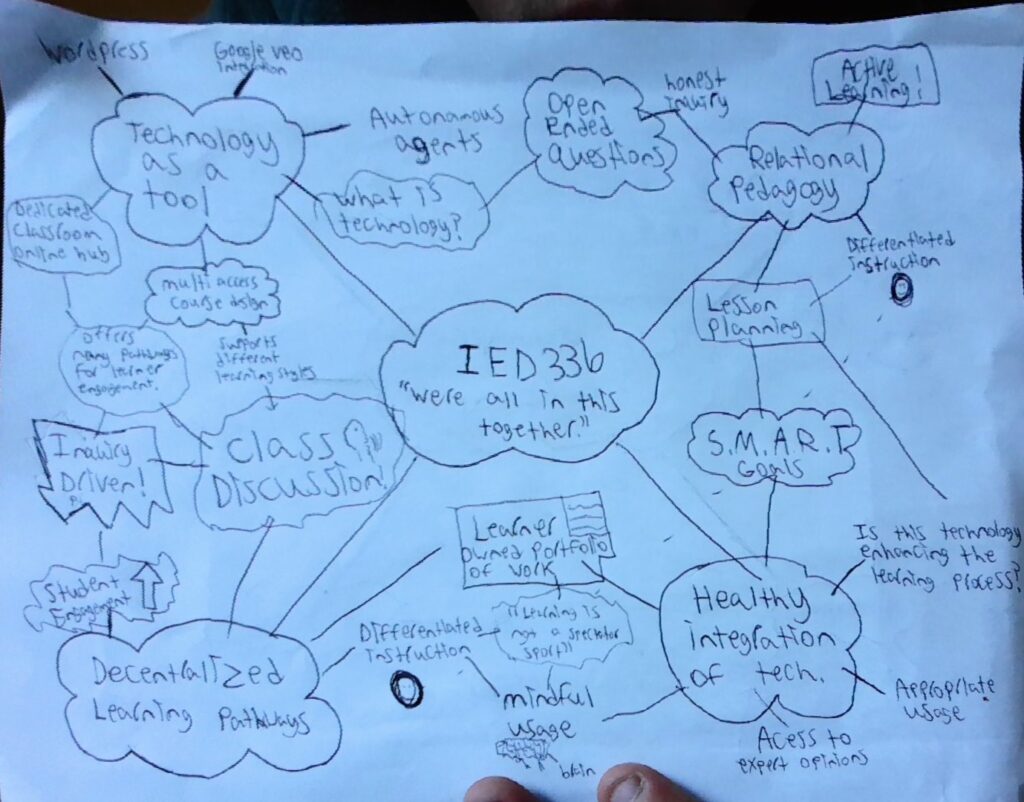
I have made a ‘mind map’ to represent my learning journey through the process of this course. The ‘mind map’ structure, in general, is a rather crude re-creation of the mental webs we make with common associative learning. However, it is a useful structure to express ideas informally, which in my case somehow makes the expression feel more honest.
It is with these benefits and limitations in mind that I have made the following mind map.
I have appreciated this class for its focus on demonstrating healthy and practical applications of technology to improve learning outcomes, promote student engagement, support different learning styles and offer many pathways for learner engagement. I hope to carry the wisdom shared during this time with me into my career as an educator.
Hello and welcome to my class. The following is all the information you should need for your lesson on the free-to-access Education Technology Tool Blooket.
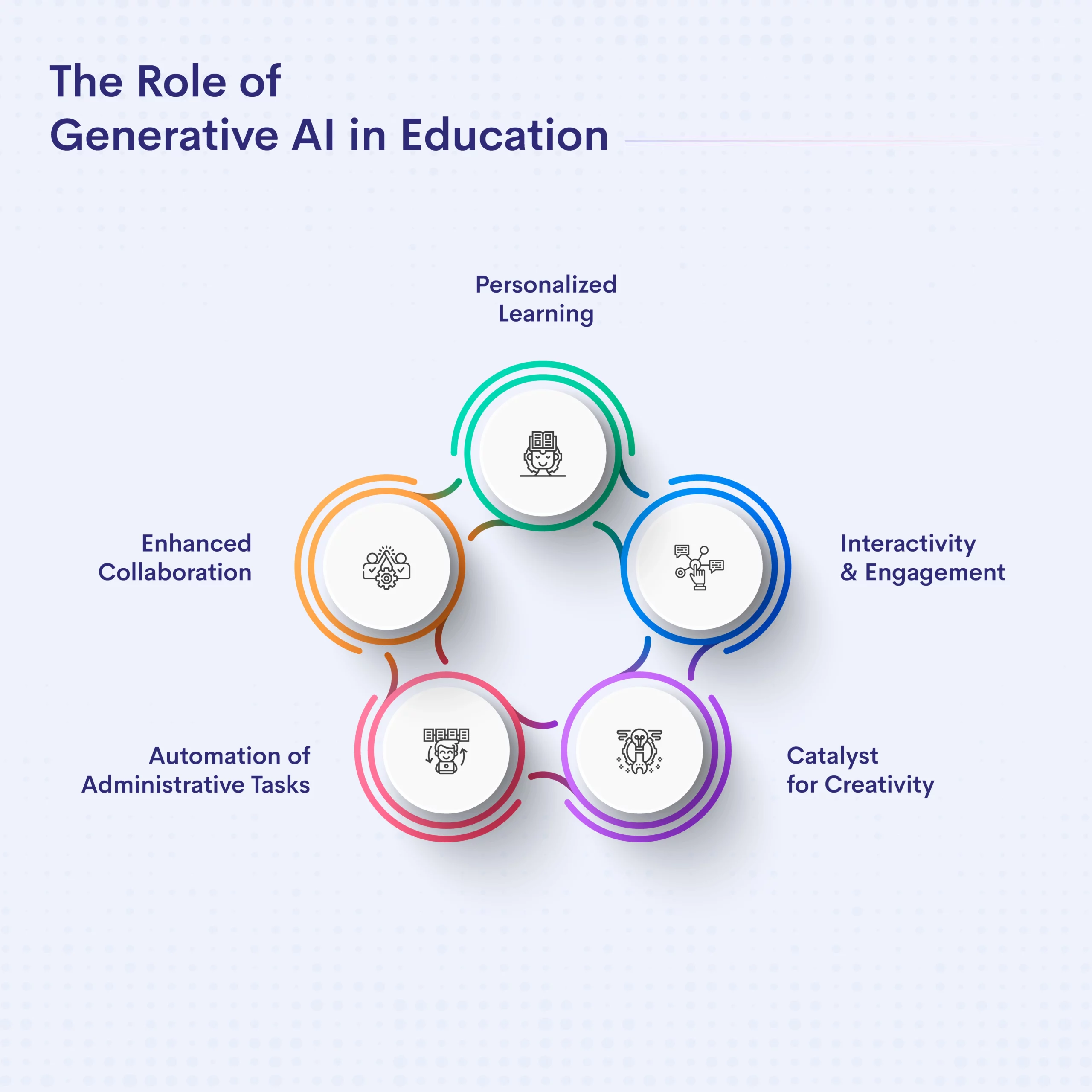
The following Blog post was generated by Gemini AI with the following two prompts. “please draft a blog post that meets the assignment criteria” (bright space assignment page linked) and “Please make this shorter and more direct, answer what the major limitations, of gen AI are, and some possible use cases in an educational setting”
The content it created is adequate, but as a student, my engagement with the material is significantly lower than if I had drafted the blog post myself. This mental outsourcing and lack of critical engagement with the material is (in my opinion) one of the biggest concerns about the use of generative AI. As a whole, I am a proponent for the potential of the technology, but it needs to be used appropriately as a tool, not as a replacement for internal thinking processes.
Navigating GenAI in Education: Limitations & Use Cases
As Generative AI (GenAI) becomes deeply embedded in modern classrooms, we have to look past the hype to evaluate its practical boundaries and actual utility. Here is a direct breakdown of its major limitations and its most effective use cases in education.
Major Limitations of GenAI
While GenAI tools can produce impressive content in seconds, they lack human cognition and present significant risks:
The “Hallucination” Factor: GenAI does not actually understand facts; it predicts strings of words based on patterns. This leads to confident misinformation—inventing historical citations, distorting scientific facts, or misinterpreting text. It requires rigorous, constant fact-checking.
Lack of Context and Empathy: AI cannot understand a student’s personal background, emotional state, or unique learning barriers. The output is fundamentally generalized and sterile, requiring heavy human intervention to make it truly useful for a diverse classroom.
Data Privacy and Exploitation: Many platforms use input data to train future models. Inputting student work or personal data into these systems poses a massive risk to student privacy and data security.
Possible Educational Use Cases
When used as a collaborative tool rather than an automated substitute, GenAI has highly practical applications for educators:
Automated Administrative Support: Teachers can use GenAI to draft routine emails, format lesson plan outlines, or generate multiple variations of quiz questions, saving hours of prep time.
Differentiated Resource Generation: It can instantly translate a reading passage into multiple reading levels or format text into structured outlines to support diverse learners.
Scaffolding and Brainstorming: For students, GenAI acts as an interactive brainstorming partner—helping them outline essays, explain complex concepts in simpler terms, or practice language conversational skills.
Use of digital Accessibility features is widespread, but not ubiquitous. Often, accessibility features are disproportionately made available based on the resources available to the content creator. Larger corporations are often better equipped to provide comprehensive accessibility support for a variety of needs.
Surprises
Digital accessibility comes in many forms for many different people. I found it surprising that visual aids come in many different forms. Including text descriptions of images and dark mode on your browser.
Conclusion
Digital accessibility is an important consideration in the modern era. There are many tools to add these features and some surprising implementations.
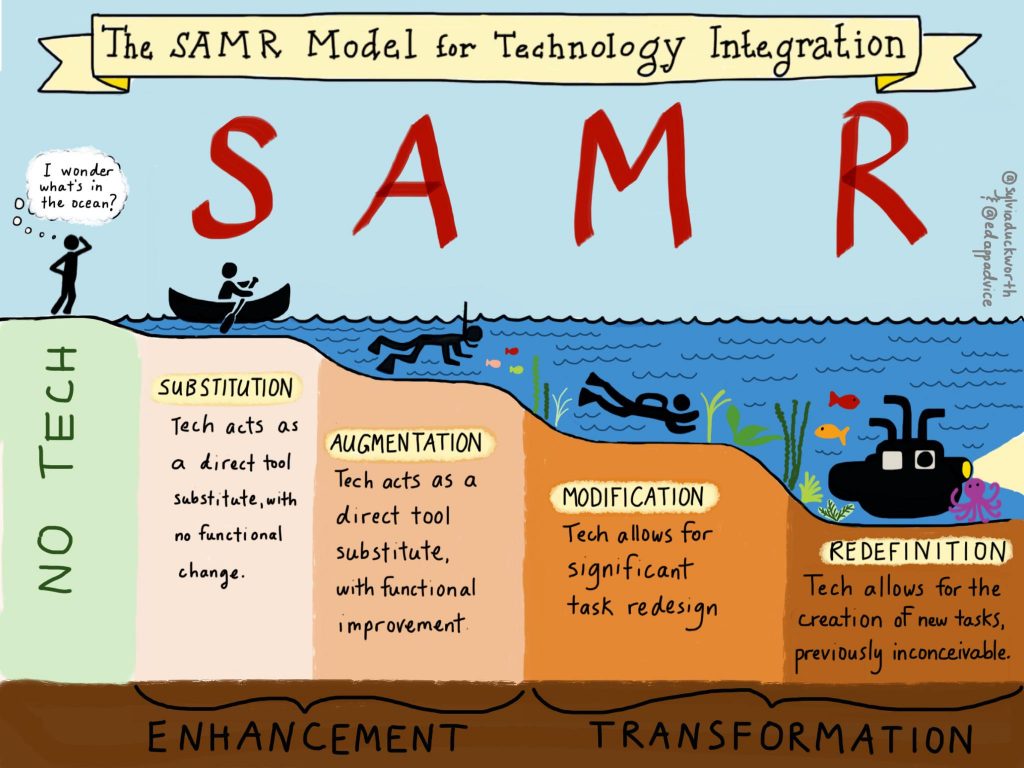
The SAMR model of technological integration (pictured below) is a useful framework for determining the necessity of technology for any given task and for showing how technology can open up doors to learning activities that would otherwise be inaccessible. For example, doing a world tour with a class using VR. The framework suggests technological integration comes in four forms ranging from a direct substitution for other teaching methods (such as a video lecture) to a complete redefinition of what the task can be and what is possible.
I think the SAMR framework is a useful tool to conceptualize the benefits of technology and to determine when a subject might not need a technological substitution.
SAMR model, illustrated by Sylvia Duckworth
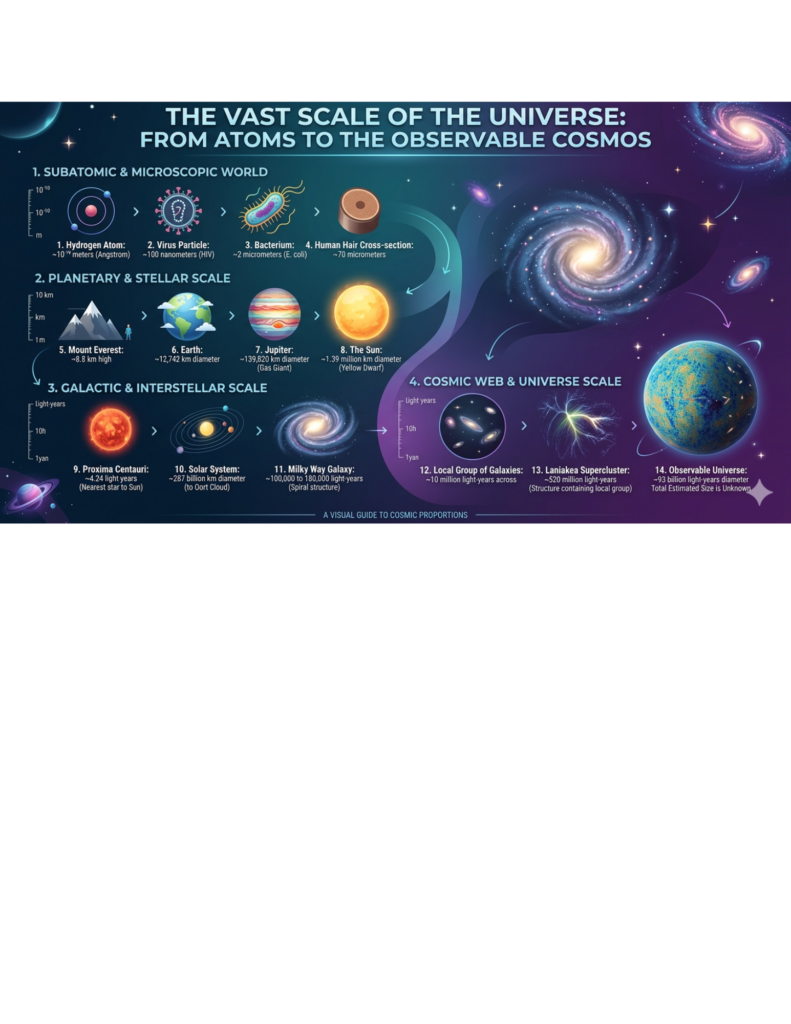
I have included an infographic on the scale of the universe, made in Canva with the help of Gemini.
Stories are everywhere, despite the insistence of material certainty in the modern world, we as subjective observers make sense of the world through story. I will digress from the philosophical and epistemological implications and move into a discussion on stories as pedagogy.
Story is wonderous and wonderfull, they spark imagination and can catch the attention of learners and make it easier for them to recall information embedded within. There are so many ways to utilize story in the classroom, but my personal favourite and one of the most intuitively obvious examples of story work is cultural fables. Stories are engaging and often exist at the edge or beyond the realm of “reality.” This is useful to spark creative thinking and complex analysis of human beliefs. Furthermore teaching with stories often increases student engagement and the novelty can help increase retention.
Ultimately, I believe story work is a quintessential aspect of developing a sense of self, a sense of place, and a sense of world. Stories are beautiful and conscious affirming. May they live long in their ethereal constantly shifting forms for many generations to come.
Short, video demonstrating my screen sharing capacity. Video shares a cool educational resource that my friend works for.
The educational landscape is changing. The last major shift occurred over a century ago as schools transformed to better create a standardized workforce for industrial development. The skills required to be an efficient and productive labourer have never been the optimal skills to live a beneficent life full of purpose and wellness. The objective of education should be greater than just vocational training but even within that narrow lense of desired educational outcomes, the world is changing. The vocational skills necessary for success are becoming more soft skill focused. Working collaboratively, effective communication, critical thinking, media literacy and creative problem solving are becoming more important than ever.
To develop healthy, informed, critically thinking citizens who can stand up to fascism and stand up for their own and others’ rights, an educational system that prioritises development, social skills, and fosters the joy of learning is of paramount importance.
This is best accomplished through inquiry based learning, a diverse breadth of expectation and opportunity and effective modelling of learning strategies. Holistic development takes time, support, and relational learning. Together we can create a better society, starting by improving our educational systems.
I am excited and slightly nervous for this class, the blog setup has gone well, though occasionally technology seems to conspire against me. The setup has been successful after some technological issues with the OpenEd WordPress server on the backend. Here’s to a term full of success and wonder!
I have included a humerous and somewhat topical comic to express my feelings about this assignment. 😉